
Old Age Pension Status
Your “old age pension status” in the US is your Social Security eligibility and estimated benefit, viewable immediately through your my Social Security account at ssa.gov/myaccount. That portal shows your earnings record, credit tally, and projected monthly payment at age 62, Full Retirement Age (FRA), and age 70.
If you haven’t created an SSA online account yet, that’s your first action. No third-party calculator or state pension system can show your US Social Security status. The official portal is the only source SSA uses when you eventually file a claim.

How Social Security Defines Your Old Age Pension Status
The US doesn’t run a program literally named “old age pension.” Social Security retirement benefits—formally Old-Age and Survivors Insurance (OASI) —serve that function. Your status comes down to two numbers:
- Credits: You earn up to 4 per year. In 2025, each $1,810 in covered earnings gives you one credit. You need 40 credits (roughly 10 years of work) to qualify for retirement benefits.
- Primary Insurance Amount (PIA): Your monthly benefit at Full Retirement Age, calculated from your highest 35 years of earnings adjusted for average wage growth. Fewer than 35 years means zero-earning years are included, which lowers the PIA.
Example: A worker born in 1960 with a steady $60,000 salary over 35 years will have a higher PIA than someone with the same earnings but only 30 years of covered work. Those five missing years each count as $0 in the calculation.
Applicability boundary: This entire answer applies only to US Social Security. If you paid into a foreign pension system (Canada Pension Plan, UK State Pension, etc.), your status is tracked by that country’s agency, not SSA. If you have a private employer pension (like a 401(k) or defined-benefit plan), it’s entirely separate—SSA doesn’t track those.
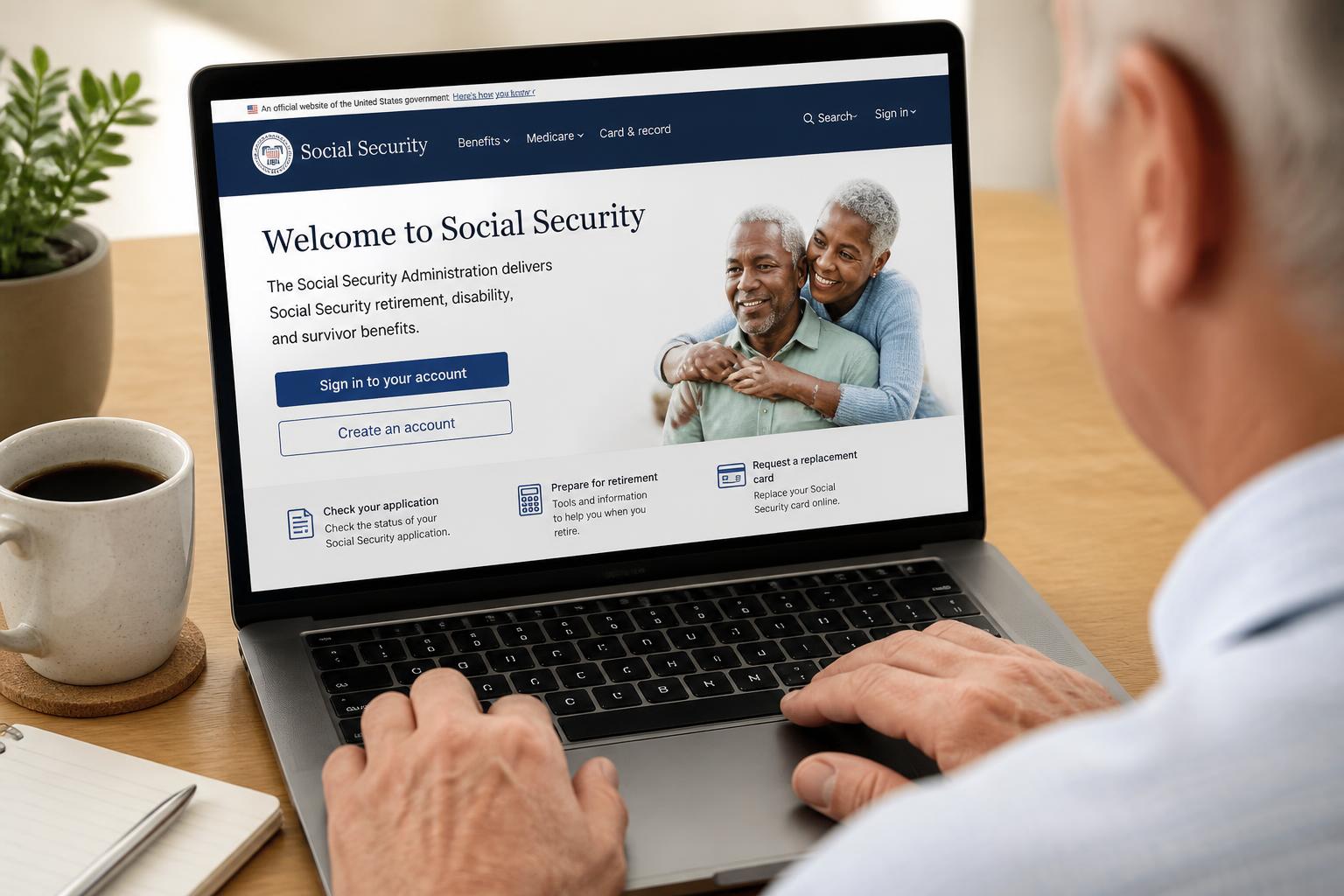
How to Check Your Status on ssa.gov
Verification has three natural checkpoints. Hitting all three confirms your status is accurate.
Preparation: What You’ll Need
- Your Social Security number
- A valid email address and phone number
- Your most recent W-2 (if employed) or tax return (if self-employed) for identity verification
Step 1: Create or Log Into Your my Social Security Account
Go to ssa.gov/myaccount. If you already have an account (from a Medicare or disability application), log in. New users click “Create an Account” and answer identity-verification questions based on your credit history. If that fails, SSA will mail a verification code.
Checkpoint 1: If you can’t create an account online, don’t assume your record is wrong. Call 1-800-772-1213 or visit a local SSA office to request a paper Social Security Statement (Form SSA-7005).
Step 2: Review Your Year-by-Year Earnings Record
The dashboard shows your estimated benefits and a full earnings history. This is the most common failure point: missing or incorrect earnings.
Checkpoint 2: Compare each year’s reported earnings against your W-2s or tax returns. SSA does not automatically fix employer reporting errors. A 2023 tax return showing $52,000 in wages that SSA recorded as $45,000 means you’re missing 7 credits for that year. Discrepancies older than three years require a formal Correction of Earnings Request (Form SSA-7008).
Step 3: Read Your Benefit Estimate
The dashboard shows three key figures:
- At age 62: The reduced early-retirement benefit (roughly 70–75% of your PIA, depending on birth year)
- At Full Retirement Age: Your full PIA amount
- At age 70: The maximum benefit with delayed retirement credits (8% per year past FRA up to age 70)
Checkpoint 3: If the FRA estimate seems lower than expected, check two things: (1) the number of years in your earnings record—fewer than 35 means zero-earning years are pulling your average down; (2) whether you have a government pension from a non-covered job, which may trigger the Windfall Elimination Provision (WEP).
Success Check
Your status is confirmed when the earnings record matches your work history, you have at least 40 credits, and you understand which benefit age you’re targeting. If the numbers don’t look right or you can’t verify your record, stop before relying on those estimates for retirement planning. Escalate to SSA directly.
Practical implication: A confirmed status lets you confidently plan your retirement age and expected monthly income. If your record is incomplete, your estimated benefit on the dashboard is lower than what you’re actually entitled to—meaning you could be planning for less money than you’ll receive, or vice versa.
Full Retirement Age by Birth Year
Your FRA determines when you receive 100% of your PIA. Claiming earlier permanently reduces it; delaying increases it.
| Birth Year | Full Retirement Age | Benefit at 62 (% of PIA) | Benefit at 70 (% of PIA) |
|---|---|---|---|
| 1943–1954 | 66 | 75.0% | 132.0% |
| 1955 | 66 + 2 months | 74.2% | 130.7% |
| 1956 | 66 + 4 months | 73.3% | 129.3% |
| 1957 | 66 + 6 months | 72.5% | 128.0% |
| 1958 | 66 + 8 months | 71.7% | 126.7% |
| 1959 | 66 + 10 months | 70.8% | 125.3% |
| 1960+ | 67 | 70.0% | 124.0% |
Action step: Find your birth year. The “Benefit at 70” figure shows the maximum you can increase your monthly payment simply by waiting.
Special Rules That Change Your Benefit
Two rules alter “old age pension status” for workers who also receive a pension from a job not covered by Social Security—typically state, local, or federal government positions under CSRS, or certain foreign pensions.
Windfall Elimination Provision (WEP)
WEP reduces Social Security benefits for workers who also get a monthly pension from a non-covered job. The reduction is capped at half the amount of that non-covered pension. For 2025, the maximum WEP reduction is $599 per month.
The concrete mismatch: The default dashboard estimate on ssa.gov may show a higher benefit than you’ll actually receive if WEP applies. SSA won’t automatically recalculate until you file. To see the real number, use the Benefit Estimation Tool and enter your non-covered pension amount manually.
Government Pension Offset (GPO)
GPO affects spousal or survivor benefits, not your own retirement benefit. It reduces the spouse’s or widow(er)’s Social Security benefit by two-thirds of their government pension from a non-covered job. If that pension is large enough, the spousal benefit drops to $0.
Example: A teacher with a state pension of $2,000/month expects a full Social Security spousal benefit of $1,200/month. After GPO: $1,200 minus (2/3 × $2,000) = $0 spousal benefit.
Verification step: SSA sends a “Personal Earnings and Benefit Estimate Statement” annually to some users. But the online dashboard may not adjust for GPO until you file. Request the GPO notice from SSA before claiming spousal benefits.
Expert Tips for Verifying and Correcting Your Status
Tip 1: Correct earnings errors within three years
Actionable step: Request Form SSA-7008 immediately when you spot a mismatch between your W-2 and the earnings record. Errors older than 3 years, 3 months require more complex evidence (tax returns, pay stubs, or employer statements).
Common mistake: Assuming SSA catches employer errors. They don’t. A 2022 earnings gap of $8,000 from a misreported W-2 is your responsibility to flag.
Tip 2: Fill missing years with late-career earnings
Actionable step: If you have fewer than 35 years of covered earnings, work at least one more year in a Social Security-covered job to replace a zero-earning year in the PIA calculation. Even one year of modest earnings can raise your PIA noticeably.
Common mistake: Retiring early at 62 with only 32 years of covered earnings. Those three zero-earning years reduce your benefit permanently, not just until age 70.
Tip 3: Verify WEP/GPO manually—don’t trust the default estimate
Actionable step: Log into ssa.gov, click “Benefit Calculators,” select “Social Security Benefit Estimation Tool,” and enter your actual non-covered pension amount. The tool recalculates the benefit with WEP applied.
Common mistake: The default dashboard estimate may show a higher number than your actual benefit if WEP applies. A teacher relying on that dashboard figure could plan for $1,200/month in spousal benefits that GPO reduces to zero.
Common Errors That Misstate Your Status
Missing Earnings from Secondary Jobs
Your employer may have incorrectly reported your SSN, used a different legal name, or simply failed to file. Detect early: Check the year-by-year earnings table on ssa.gov annually. A year marked “$0” when you worked that year is a red flag.
False Assumption About Non-Covered Work
Workers who spent years in a state teacher’s pension system or as a federal employee under CSRS may assume they have zero Social Security coverage. Detect early: Add up your years in Social Security-covered jobs separately. Even a few private-sector years can earn credits and trigger WEP.
Treating a Foreign Pension Like US Social Security
If you paid into a pension system outside the US (Canada Pension Plan, UK State Pension), you don’t check that status on ssa.gov. Detect early: Search that foreign pension agency’s website. SSA only tracks US-covered earnings and certain totalization agreements.
Frequently Asked Questions
Can I check my old age pension status by phone?
Yes, call SSA at 1-800-772-1213 (TTY 1-800-325-0778) to request a paper Social Security Statement mailed to you. The online portal gives you the full earnings record and benefit estimates immediately, though.
What if I never worked enough to earn 40 credits?
Without 40 credits, you aren’t eligible for retirement benefits based on your own work record. You may still qualify for spousal benefits on your spouse’s record if they have enough credits.
Does my old age pension status change if I keep working after I start collecting?
Yes. If you claim Social Security before your FRA and continue working, your benefit may be temporarily reduced through the Retirement Earnings Test. In 2025, the exemption is $23,400 per year. After FRA, there’s no reduction.
Disclaimer: This article provides general information about Social Security eligibility and benefit estimates. It is not financial or legal advice. Benefit amounts, earnings thresholds, and rules change annually. Confirm your specific status and any WEP/GPO impact directly with the Social Security Administration at ssa.gov or by calling 1-800-772-1213.
Explore This Topic
Related guides in this cluster:

Michael Reynolds is a retirement benefits researcher and the lead author at Pension FAQ. With over 12 years of experience analyzing employer pension plans, state retirement systems, and Social Security policy, he specializes in translating complex pension rules into clear, actionable guidance for American workers and retirees.
Michael holds a Bachelor’s in Economics from the University of Michigan and has completed the Certified Retirement Counselor (CRC) program. His work has been cited by financial planners and HR professionals helping employees navigate their pension options.
At Pension FAQ, Michael leads a team covering employer plan access, state pension taxation, teacher and public employee retirement systems, professional sports pensions, and pension calculation rules. All content is rigorously reviewed against official plan documents and IRS guidelines.
Disclaimer: Pension FAQ content is for educational purposes only and does not constitute financial, tax, legal, or retirement benefits advice. Always consult your plan administrator or a qualified professional for decisions about your specific situation.