
Reporting Canada Pension Plan Benefits on Form 1040
Quick Answer: How To Report Canadian Pension Income On 1040
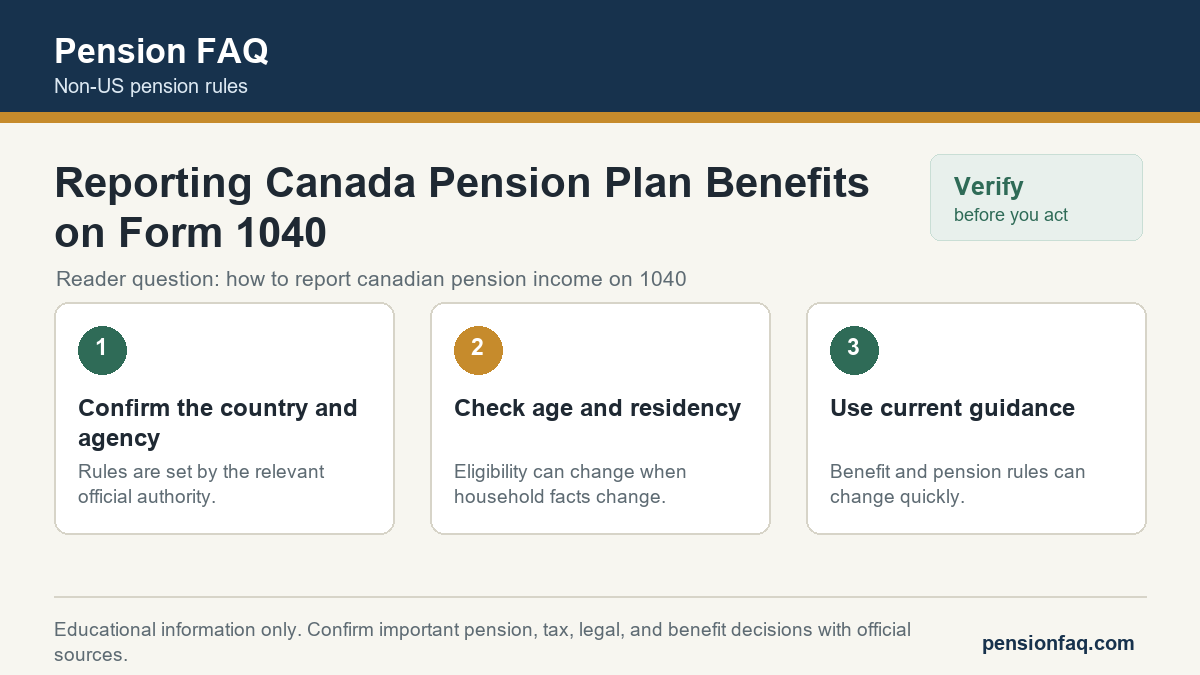
For how to report canadian pension income on 1040, confirm the current rule with the official government or pension authority in the relevant country. Non-US pension and benefit rules often change by country, age, residency, and household circumstances.
| Check first | Why it matters |
|---|---|
| Country and agency | The correct rule depends on the official pension authority. |
| Residency and age | Benefit eligibility may change when you move or reach a pension age. |
| Current guidance | Use current official guidance before acting. |
Before you act: Because this is not a US-first pension topic, confirm the rule with the relevant country’s official pension or benefit authority before acting. For site standards and limits, see our Financial and Pension Disclaimer and Pension Methodology.
If you’ve received Canada Pension Plan (CPP) benefits, you might be wondering, "where do I report Canada Pension Plan on 1040?" Understanding how to navigate this process is essential for accurately filing your taxes. You’ll need to determine whether your CPP income is taxable and how it fits into your overall financial picture. This article will guide you through reporting your CPP benefits on Form 1040 and help you avoid common pitfalls. With the right information, you can ensure you’re compliant and make the most of your cross-border tax situation.
Understanding Canada Pension Plan Benefits
Canada Pension Plan benefits are an important source of income for you during retirement. You’ll receive these benefits based on your contributions throughout your working years. They’re designed to replace a portion of your pre-retirement income. Depending on your earnings, the amount you get can vary significantly. You may start receiving your benefits as early as age 60, but your payments will be reduced if you opt for them early. Delaying your benefits can increase the monthly amount you receive. You’re eligible for full benefits at age 65, which is when most people start. Understanding how these payments work is crucial for your financial planning. You’ll want to ensure you report them correctly when filing your taxes.
Determining Taxability of CPP Income
Determining the taxability of your CPP income can affect how much you owe when you file your taxes. You need to know that CPP benefits are generally considered taxable income in the United States. However, the amount that’s taxable may depend on your total income and filing status. If your combined income exceeds certain thresholds, a portion of your CPP benefits could be subject to tax. It’s important to gather all relevant documentation to accurately assess your tax situation. You’ll also want to consult IRS guidelines to ensure you comply with all reporting requirements. Understanding how your CPP benefits interact with other income sources is key to determining your overall tax liability. Be mindful that withholding options can impact your tax outcome as well. Next, we’ll look at the specifics of reporting CPP benefits on Form 1040.
Reporting CPP Benefits on Form 1040
You’ll need to include your CPP benefits as income when filing your Form 1040. It’s crucial to gather all your CPP statements for accuracy. You should report the total amount received during the tax year. If you received any tax slips from Service Canada, keep those handy. You’ll enter this information on the appropriate line of your Form 1040. Remember that you may need to convert the amounts to US dollars if they were in Canadian currency. You might also want to consult tax software or a tax professional for guidance. Don’t forget about any potential deductions or credits you may qualify for. Filing accurately ensures you’re in good standing with the IRS.
Claiming Foreign Tax Credits
Claiming foreign tax credits can help reduce your overall tax liability on income earned from sources outside the U.S. You’ll often find that these credits offset the taxes you’ve already paid to foreign governments. This can be especially beneficial if you’ve received income from Canadian sources, such as the Canada Pension Plan. It’s essential to report this income accurately to maximize your credit. You can claim the credit on Form 1116, which will guide you through the necessary calculations. Keep in mind that you can only claim credits for taxes that are legally owed to the foreign country. Make sure to maintain proper documentation of your foreign income and tax payments. It’s also crucial to file your U.S. tax return on time to avoid penalties. Knowing these details can help you claim your credits effectively, but be aware of common mistakes to avoid.
Common Mistakes to Avoid
Common mistakes to avoid include not reporting all your CPP benefits, which can lead to discrepancies in your tax return. You might also forget to convert your benefits from Canadian dollars to U.S. dollars accurately. Using the wrong exchange rate can skew your reported income. Failing to check if you’re eligible for tax credits can result in missed savings. You shouldn’t overlook the importance of keeping detailed records of your CPP payments. It’s easy to misinterpret the tax implications of receiving benefits while living abroad. You could also confuse the reporting requirements for different tax years. Not seeking professional advice can leave you vulnerable to errors. Understanding these pitfalls is crucial before navigating the complexities of tax reporting; next, let’s explore the resources available for cross-border taxpayers.
Resources for Cross-Border Taxpayers
Resources for cross-border taxpayers can help you navigate the complexities of reporting Canada Pension Plan benefits on Form 1040. You’ll find various online platforms offering tax advice specifically tailored for cross-border situations. Many tax professionals specialize in both Canadian and U.S. tax law, ensuring you’re not missing anything. Online forums can also provide valuable insights from others who’ve faced similar challenges. You can access IRS publications that outline the requirements for reporting foreign income, including pension benefits. Additionally, the Canada Revenue Agency offers resources that clarify how pension income is treated for tax purposes. Using software designed for cross-border tax situations can simplify the process significantly. Don’t forget to consult with tax advisors who have experience with both tax systems. Staying informed can save you time and potential penalties down the road.
Frequently Asked Questions
How do cpp benefits affect eligibility for other government assistance programs in canada or the u.s.?
CPP benefits can influence your eligibility for various government assistance programs in both Canada and the U.S. In Canada, receiving CPP benefits might affect your income level, which could impact your qualification for programs like social assistance or housing subsidies. In the U.S., some assistance programs consider your total income, including pensions, so your CPP benefits might reduce your eligibility for programs like Medicaid or food assistance. It’s important to check the specific guidelines of each program because the rules can vary widely. If you’re unsure, consulting a financial advisor or a social worker can help clarify how these benefits might affect your situation. Staying informed about these interactions will help you maximize your assistance options.
What documentation is required to prove the receipt of cpp benefits?
To prove you’ve received Canada Pension Plan (CPP) benefits, you’ll need a few key documents. First, your annual CPP benefits statement is essential, as it outlines the amount you’ve received throughout the year. You can also use your Social Insurance Number (SIN) to help verify your benefits when needed. If you’ve set up direct deposit, your bank statements showing the deposited amounts can serve as additional proof. Don’t forget to keep any tax documents related to your CPP benefits, as they can also be helpful for verification. Lastly, if you ever need to provide proof for any specific reason, contacting the CPP directly for a benefits verification letter might be a good idea.
Are there any penalties for incorrectly reporting cpp benefits on form 1040?
If you incorrectly report any income, including benefits from the Canada Pension Plan, you might face penalties from the IRS. The severity of the penalty can depend on whether the mistake was due to negligence or if it was willful disregard of the rules. If you realize you’ve made an error, it’s often best to correct it as soon as possible to minimize potential consequences. In some cases, you could also be subject to interest on any unpaid tax due to the incorrect reporting. It’s crucial to keep accurate records and double-check your entries to avoid these issues. If you’re unsure, consulting a tax professional can help you navigate these complexities and ensure you’re compliant.
If you’re navigating the complexities of pension benefits as a surviving spouse, I highly recommend visiting this informative page on understanding city pension benefits for surviving spouses. It provides valuable insights that can help you better understand your rights and options. Check it out here: surviving spouse city pension.

Michael Reynolds is a retirement benefits researcher and the lead author at Pension FAQ. With over 12 years of experience analyzing employer pension plans, state retirement systems, and Social Security policy, he specializes in translating complex pension rules into clear, actionable guidance for American workers and retirees.
Michael holds a Bachelor’s in Economics from the University of Michigan and has completed the Certified Retirement Counselor (CRC) program. His work has been cited by financial planners and HR professionals helping employees navigate their pension options.
At Pension FAQ, Michael leads a team covering employer plan access, state pension taxation, teacher and public employee retirement systems, professional sports pensions, and pension calculation rules. All content is rigorously reviewed against official plan documents and IRS guidelines.
Disclaimer: Pension FAQ content is for educational purposes only and does not constitute financial, tax, legal, or retirement benefits advice. Always consult your plan administrator or a qualified professional for decisions about your specific situation.